[The 'Global Union' & Digital Sanctuaries]
Download AiR Report
[The 'Global Union' & Digital Sanctuaries]
Theoretical Framework and Strategic Implementation Archive Report for the TEAM LEWIS Foundation
Prepared by: Dr Joshua Y'Barbo, Corporate Artist-in-Residence (AiR)
This collection of research entries documents the development of the "Digital Sanctuary"—a participatory design methodology I am proposing to support hybrid collaboration, reduce digital fatigue, and foster professional well-being, which aligns with developing an operational framework to support our association with an international partnership consortium spanning the UK, Belgium, Portugal, and the US and involving TEF/REF/KE outcome.
1. Conceptual Origin: The "Digital Sanctuary" (2020–2021)
- The Problem: Documenting the collapse of traditional physical workshop and collaboration spaces during global shifts to remote working, and the resulting challenges in maintaining meaningful professional cohesion and creative well-being.
- The Innovation: The "Digital Sanctuary" was prototyped through low-fatigue, step-by-step participatory models designed to protect creative focus and foster cognitive parity.
- The Concrete Evidence: This methodology was physically established through your curated creative workshops. For example, your Autumnal Art Club was designed to combat seasonal isolation and remote fatigue, using accessible, structured drawing and painting frameworks.
- Strategic Outcome: The asynchronous creative structures I developed with TEAM LEWIS Foundation now shape my post‑pandemic academic work on community engagement and ESG, especially my interest in protected creative spaces as an alternative to always‑on digital interaction.
2. Scaling to the "Global Union" (2022–2024)
- Transition: Portfolio documentation details the expansion of the Digital Sanctuary from localised well-being workshops into a strategic framework for managing "technical constraints" across global networks.
- Consortium Architecture: Documenting how asynchronous support structures, digital residencies, and collaborative curatorial tools allow UAL to maintain a constant, high-value Knowledge Exchange (KE) with partners in Kentucky, Porto (PT) and Antwerp (BE).
- The Concrete Evidence: This operational model is demonstrated on my blog by my cross-border curatorial collaboration for the Never Such Innocence (NSI) “How Can We Prevent Future Wars?” Exhibition displayed at the TEAM LEWIS Foundation in Battersea, London. It proves how digital coordination and local physical delivery can bypass the logistical, financial, and environmental costs of traditional international setups.
- Strategic Outcome: The development of a reciprocal "Consortium" model where shared digital tools facilitate co-design across borders, directly contributing to UNSDG Goal 17 (Partnerships for the Goals).
3. Current Implementation: The International Consortium (2025–2026)
- Operational Excellence: Recent portfolio entries serve as a robust "Proof of Concept" for the consortium, demonstrating how Erasmus+ KA1 & KA2 project outputs are hosted, delivered, and disseminated.
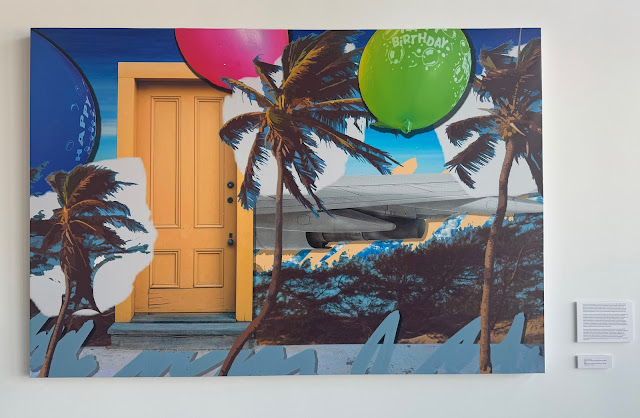
- The Concrete Evidence: My active translation of complex policy into speculative educational tools is proven by your published curriculum designs, such as the Art Lesson: Creating a Fair World for All Women and Girls (addressing gender equality, racial equity, and UNSDG themes), and the physical installation of your commissioned prints, Home in the Wind (2024–2025), at the Battersea Power Station office.
- Social Impact of the Arts: Utilising this infrastructure to drive advanced, collaborative co-design initiatives that support diverse, neurodivergent, and international student cohorts—proving that rigorous creative research must be measured by its tangible, real-world human impact and ethical contribution to society.


Comments
Post a Comment